How Meditation Actually Works (Explained Without the Woo)
Meditation has a branding problem. Depending on where you encounter it, it can sound like either an ancient path to enlightenment or something a productivity influencer does for 20 minutes before answering emails. Somewhere between incense, meditation apps, silent retreats, and promises of a completely calm mind, the basic idea has become more complicated than it needs to be.
By Ricardo Turner on August 18, 2026
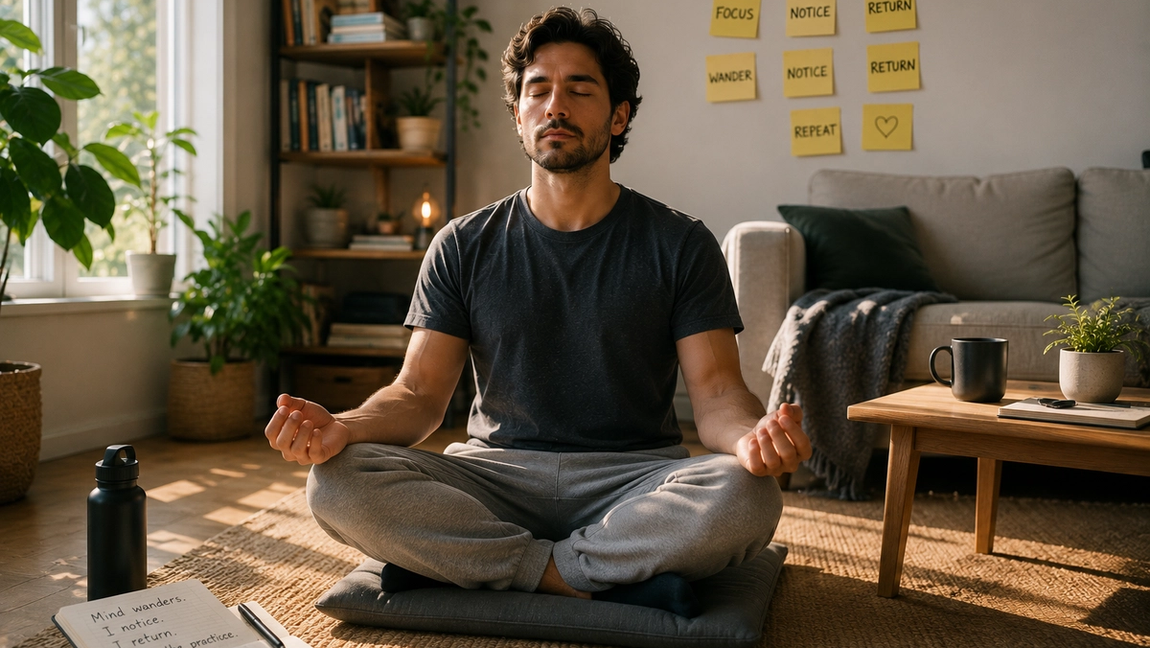
Meditation has a branding problem. Depending on where you encounter it, it can sound like either an ancient path to enlightenment or something a productivity influencer does for 20 minutes before answering emails. Somewhere between incense, meditation apps, silent retreats, and promises of a completely calm mind, the basic idea has become more complicated than it needs to be.
At its simplest, meditation is a form of attention training. You deliberately focus your attention on something—often your breathing, physical sensations, sounds, or thoughts—and practice noticing when your mind wanders. Then you bring your attention back. There is no requirement to stop thinking, achieve a special mental state, or become unusually peaceful. In fact, realizing how frequently your mind wanders is part of the practice.
Your brain is supposed to wander
One of the biggest misconceptions about meditation is that you are supposed to empty your mind. People sit down, think about dinner within 15 seconds, remember an awkward conversation from 2018, and conclude that they are terrible at meditating.
But thoughts appearing does not mean the meditation has failed. The basic exercise is noticing that your attention has moved and deliberately redirecting it. If you are focusing on your breathing and suddenly realize you have spent the last minute mentally planning tomorrow, the moment you notice is actually important. You have become aware of where your attention went.
Think of it less like holding your attention perfectly still and more like practicing a repetition at the gym. Focus, wander, notice, return. That cycle can happen dozens of times during a session. The returning is the practice.
Meditation trains attention
Attention often feels automatic. A notification appears and you look at it. Someone says something irritating and you replay it for an hour. You open your phone to check the weather and somehow end up watching videos ten minutes later.
Meditation creates a small environment in which you deliberately practice choosing where your attention goes. During a basic breathing meditation, for example, you might notice the sensation of air entering and leaving your nose. Eventually, a thought, sound, itch, or memory pulls you away. Once you recognize that your attention has shifted, you return it to your breathing.
Over time, that practice may make you more aware of where your attention goes outside meditation as well. You may notice yourself getting distracted sooner or recognize that you have been caught in the same repetitive thought for several minutes. Meditation does not give you perfect control over your attention, but it can help you become less automatic about where you direct it.
You learn to observe thoughts without immediately following them
Imagine you receive a short email from your manager saying, “Can we talk tomorrow?”
Your brain may immediately produce a story. Something must be wrong. Maybe you made a mistake. Perhaps the meeting you thought went well actually went badly. Within minutes, you are mentally experiencing consequences that have not happened.
Meditation can help create a little distance between having a thought and believing or acting on it. During practice, you might notice worry appearing and simply recognize, “I’m worrying.” You do not have to solve the thought, argue with it, or make it disappear. You notice it and return your attention to whatever you were focusing on.
That skill can be useful in everyday situations. A thought can be real without being accurate, urgent, or worthy of immediate action. Meditation gives you repeated practice in recognizing that distinction.
The goal isn’t to feel calm every time
Meditation is often marketed as a relaxation technique, and it certainly can feel relaxing. But relaxation is not guaranteed.
Some sessions are peaceful. Others are boring, restless, uncomfortable, or filled with thoughts. If you sit quietly after an overwhelming day, you may initially become more aware of how tense or mentally busy you already are.
That does not automatically mean meditation is making things worse. You may simply be noticing what was already happening.
This is why judging meditation entirely by how relaxed you feel afterward can be misleading. The broader goal is awareness: noticing thoughts, emotions, sensations, and attention more clearly without automatically reacting to everything that appears.
Calm can be a welcome side effect, but it does not have to be the scoreboard.
You don’t need to meditate for an hour
The image of someone sitting perfectly still for an hour can make meditation feel inaccessible. Fortunately, you can start much smaller.
Five minutes is enough to understand the basic practice. Sit somewhere reasonably comfortable, set a timer, and choose something to focus on. Your breathing is convenient because it is always available. Notice what breathing physically feels like rather than trying to breathe in a particular way.
Your mind will wander. When you notice it, bring your attention back. Repeat until the timer ends.
Guided meditation can also be useful if sitting silently feels strange. A teacher or app provides instructions throughout the session, which can give your attention something more structured to follow. Walking meditation and body scans are other options for people who dislike focusing solely on breathing.
There is no prize for choosing the most difficult version.
Consistency matters more than intensity
Meditating for 45 minutes once every three months is unlikely to create much of a habit. A shorter practice repeated regularly is generally easier to integrate into daily life.
Attach meditation to something you already do. You might practice for five minutes after making your morning coffee, before opening your laptop, or after getting into bed. Keeping the barrier to entry low makes it easier to continue on busy days.
It is also worth being realistic about what meditation can and cannot do. Meditation is not a replacement for sleep, exercise, supportive relationships, medical treatment, or mental health care when those are needed. It is one tool among many for working with attention, stress, and emotional reactions.
Meditation is simpler than it looks
You do not need special clothing, a perfectly quiet room, expensive equipment, or a particular belief system to meditate. You do not even need to be particularly good at sitting still.
You need something to pay attention to and a willingness to notice when your mind goes somewhere else.
That is essentially the exercise: focus, wander, notice, return.
With repetition, you may become better at catching your attention before it disappears down another mental rabbit hole. You may notice emotions before immediately reacting to them, or recognize thoughts as thoughts rather than instructions.
No mystical transformation is required. You are simply practicing the ability to notice what your mind is doing while it is doing it—and choosing, when possible, what to do next.