Why the World Feels Faster Than Ever (And What to Do About It)
There are still 24 hours in a day, yet modern life can feel as though someone quietly increased the speed.
By Dion Spears on August 18, 2026
There are still 24 hours in a day, yet modern life can feel as though someone quietly increased the speed.
Messages arrive instantly. News changes by the hour. Trends appear and disappear before you have understood them. Work follows us home through laptops and phones. Entertainment is available endlessly, shopping happens in seconds, and there is always another notification waiting somewhere. Even rest can feel rushed because part of us is already thinking about what needs to happen next.
Technology has genuinely made many parts of life faster. But the feeling of acceleration is not only about technology. It also comes from how much information, choice, communication, and expectation we are trying to fit into the same amount of time.
The solution is probably not to escape modern life completely. It is to understand where the feeling of speed comes from—and deliberately create places where it does not get to control the pace.
Everything arrives immediately now
Waiting used to be built into everyday life. Letters took days. Photographs had to be developed. Television programs appeared at specific times. If someone was not home when you called, you simply tried again later.
Most of us would not want to return to all of those inconveniences. Instant communication and information are enormously useful.
But speed changes expectations.
When messages can arrive immediately, replies can begin to feel as though they should arrive immediately too. When packages can appear tomorrow, waiting a week feels unusually slow. When answers are available within seconds, uncertainty becomes harder to tolerate.
Convenience gradually becomes the baseline.
The problem is not that things happen quickly. It is that once we become accustomed to speed, ordinary waiting begins to feel like something has gone wrong.
We’re processing more information than we realize
A person can encounter hundreds of pieces of information before lunchtime.
There are messages, emails, headlines, videos, advertisements, photographs, comments, work updates, calendar reminders, podcasts, and conversations. Much of it is individually insignificant, but together it creates a constant stream of things asking to be noticed.
Your brain has to repeatedly decide what matters, what can be ignored, what requires a response, and what should be remembered.
That can make a relatively ordinary day feel mentally crowded.
The internet has not simply given us access to more information. It has dramatically reduced the effort required for information to reach us. You no longer have to go looking for most of it. It arrives automatically.
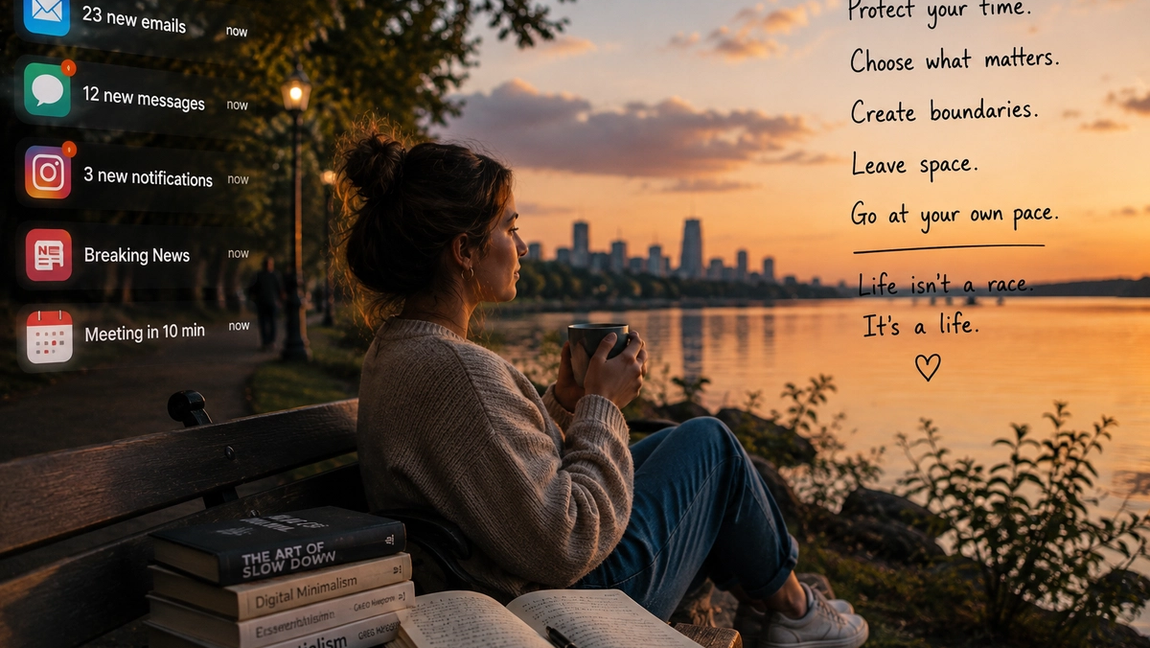
Reducing that flow can change how fast life feels. Turning off unnecessary notifications, checking news intentionally rather than continuously, and unsubscribing from things you never read are small ways of reducing the number of inputs your brain has to process.
Work no longer has clear edges
For many people, work used to be more strongly connected to a physical place. You left the office, shop, school, or workplace and created at least some distance from the job.
Digital work can follow you almost anywhere.
An email arrives during dinner. A colleague sends a message in the evening. You remember a task and reopen your laptop. Even if you do not respond, simply seeing the notification can bring work mentally back into the room.
This creates a strange situation where the workday technically ends but never completely disappears.
Creating boundaries therefore requires more deliberate effort. Turn off work notifications after a certain time when possible. Close the laptop and put it somewhere you cannot casually reopen it. Write tomorrow’s tasks down before finishing so you do not have to keep mentally rehearsing them.
The goal is not to pretend work does not exist. It is to give it somewhere to stop.
We’re constantly switching contexts
One reason modern life can feel exhausting is that we rarely do only one thing for very long.
You begin writing something, answer an email, return to the document, check a message, join a meeting, look something up, respond to another notification, and eventually wonder why a relatively simple task took two hours.
Every switch has a small mental cost.
The problem is not necessarily multitasking in the obvious sense of trying to perform two difficult tasks simultaneously. It is the repeated movement between unrelated contexts.
Reducing these transitions can make time feel less fragmented. Check email at natural intervals rather than continuously. Finish one small task before opening another. Put your phone somewhere else for thirty minutes while doing work that requires concentration.
A calmer day does not necessarily contain fewer responsibilities. Sometimes it simply contains fewer interruptions between them.
We mistake urgency for importance
Modern communication is extremely good at making things feel urgent.
A notification appears now, so it feels as though it requires attention now. An email arrives with a red exclamation mark. A headline says something is “breaking.” A message sits unread and creates a tiny sense of unfinished business.
But urgency and importance are different.
Some of the most important things in life rarely arrive as notifications. Relationships, health, long-term projects, learning, creative work, and rest usually do not demand attention every five minutes.
They are easy to postpone precisely because they are not constantly interrupting us.
One way to slow life down is to decide what matters before the day begins. If you know the two or three things that genuinely deserve your attention, every incoming request becomes easier to evaluate.
Otherwise, whatever appears most recently can quietly become the priority.
Stop filling every empty minute
A few minutes of nothing can now feel like wasted time.
We listen to podcasts while walking, check messages while waiting for elevators, watch videos while eating, and scroll while standing in line. Even activities that once provided natural pauses are filled with information.
There is nothing wrong with enjoying content during these moments. But when every gap is filled, the day can begin to feel like one continuous stream of stimulation.
Try leaving some spaces empty.
Walk for ten minutes without headphones. Drink coffee without checking anything. Sit on a train and look out the window. Wait for someone without immediately reaching for your phone.
These moments may initially feel boring. That is partly the point.
A little boredom gives your mind time to wander, process, and notice where you actually are.
Put slower things back into your life
Some activities naturally resist acceleration.
Cooking from scratch takes time. Reading a physical book requires moving through one page after another. Gardening follows biological schedules. Walking somewhere takes however long the distance requires. A long conversation cannot be meaningfully watched at double speed.
These activities create a different relationship with time because they cannot be endlessly optimized.
You do not need to build an entire lifestyle around “slow living.” Simply having a few activities that require patience can create contrast with the speed of everything else.
Read. Cook. Walk. Make something. Sit somewhere without needing to document it.
The purpose is not productivity. It is experiencing time at the speed the activity actually requires.
Don’t turn slowing down into another goal to optimize
There is a funny trap hidden inside the desire for a calmer life: you can turn calmness into another performance metric.
Suddenly you need the perfect morning routine, daily meditation, carefully scheduled screen-free time, three hobbies, journaling, long walks, and an aesthetically pleasing cup of tea before sunrise.
Now slowing down has become another exhausting project.
You do not need to optimize relaxation.
Choose one or two boundaries that make your days feel less crowded. Maybe you stop checking email after dinner. Perhaps you take one walk without your phone. Maybe Sunday mornings remain unscheduled.
The point is not to perform slowness correctly. It is to create a little more space.
You don’t need to match the world’s speed
The world is unlikely to become slower. Communication will probably become faster, information more abundant, and technology increasingly capable of removing delays from everyday life.
But external speed does not have to become your internal pace.
You can answer some messages later. You can ignore a trend. You can read something slowly. You can leave an evening unscheduled. You can spend an hour doing one thing without trying to make the hour more efficient.
The world may continue accelerating around you.
The useful skill is learning that you do not always have to accelerate with it.