How Some Songs, Films, and Books Stay With Us Forever
You can forget almost everything about a particular year and still remember the song you played constantly during it. A film you watched as a teenager can remain strangely important decades later. A sentence from a novel can return to you unexpectedly while driving, cooking dinner, or going through something the author could never have known you would experience.
By Jaxtyn Ellis on August 18, 2026
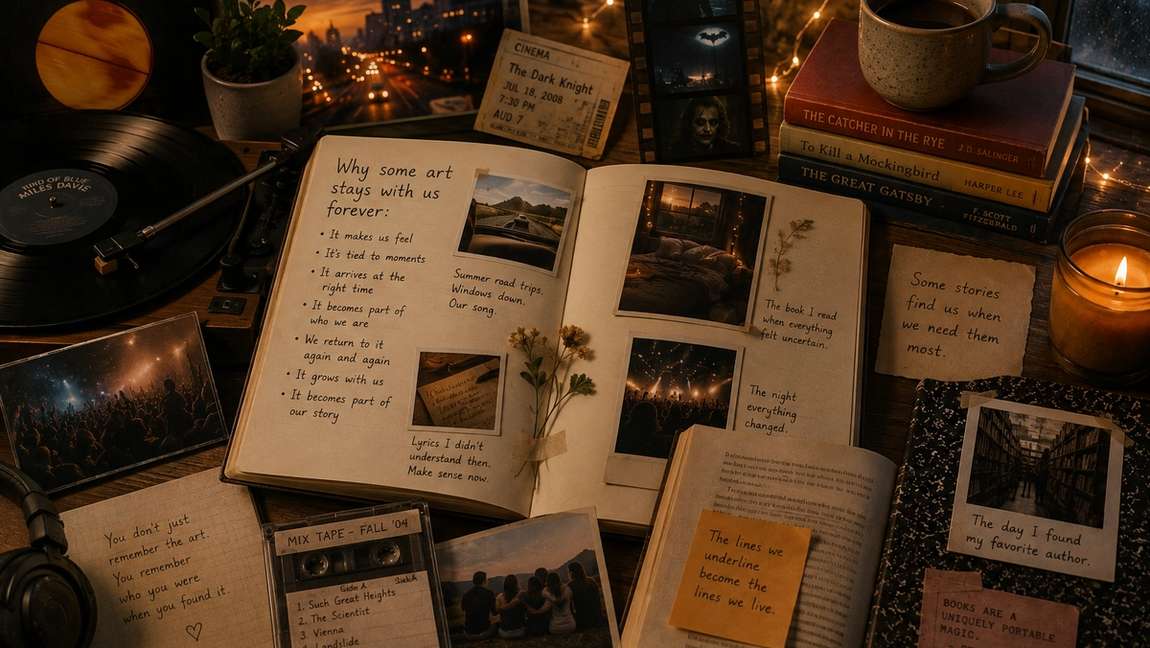
You can forget almost everything about a particular year and still remember the song you played constantly during it. A film you watched as a teenager can remain strangely important decades later. A sentence from a novel can return to you unexpectedly while driving, cooking dinner, or going through something the author could never have known you would experience.
Meanwhile, thousands of other songs, films, and books disappear from memory almost completely.
The difference is not always quality. Some masterpieces leave us impressed but emotionally untouched, while a relatively ordinary song can become inseparable from a particular person, place, or period of life. The art that stays with us often does something beyond entertaining us. It becomes attached to memory, identity, emotion, and the stories we tell ourselves about who we were.
We remember how something made us feel
Memory does not treat every experience equally. Emotion can make certain moments more memorable, particularly when an experience feels significant, surprising, exciting, frightening, or deeply moving.
Art is unusually good at creating those emotional moments. A song can change your mood within seconds. A film can make you care about fictional people you met two hours earlier. A novel can make you feel understood by someone who wrote the words decades before you were born.
That emotional response gives the experience weight.
You may eventually forget the details of a novel’s plot but remember how lonely it made you feel. You might forget most of a film while clearly remembering one scene that devastated you. You may not have heard a particular song for fifteen years, yet the opening notes immediately bring back an emotion you thought had disappeared.
What stays is not always the content itself. Sometimes it is the feeling attached to it.
Art becomes connected to specific moments in our lives
Certain songs are almost impossible to separate from the circumstances in which we heard them.
The album you played during your first year away from home becomes connected to that period. A film you watched repeatedly with someone you loved can remind you of that relationship years later. A novel read during a difficult summer can become part of how you remember surviving it.
The artwork becomes a retrieval cue for a larger collection of memories.
This is why an old song can suddenly make the past feel unusually close. You are not only remembering the music. You may remember where you lived, who you spent time with, what you wanted, what you worried about, and what you believed your future would look like.
Music can be particularly powerful because songs are often repeated. A favorite track may accompany dozens of drives, parties, walks, and ordinary afternoons, giving it multiple connections to the same period of life.
Years later, pressing play can feel almost like opening a door.
Timing matters as much as quality
Sometimes we encounter a work of art at exactly the right moment.
A book about ambition feels different when you are deciding what to do with your career. A film about family may affect you differently after becoming a parent. A song about heartbreak can sound almost unbearably accurate when you are experiencing one yourself.
The same work encountered five years earlier might have produced a completely different response.
This is one reason recommendations can be unpredictable. Someone tells you a novel changed their life, you read it, and your reaction is simply, “That was good.” The book may be excellent, but you met it under different circumstances.
Art interacts with whatever the audience brings to it. Your age, experiences, relationships, fears, ambitions, and current emotional state all influence what you notice.
Sometimes a book does not become important because it contained the perfect words. It becomes important because you happened to need those words when you found them.
We attach art to our identities
The things we love can become part of how we understand ourselves.
Teenagers do this visibly. Music, films, books, clothes, and subcultures become ways of saying, “This is the kind of person I am.” But adults continue doing versions of the same thing. We recommend favorite books, make playlists, display records, quote films, and feel an immediate connection when someone loves something we love.
Certain works become markers in our personal histories. There was the band you loved at sixteen, the author you discovered at university, the film you watched during a particular relationship, and the album that accompanied your first months in a new city.
Our tastes change, but older favorites can remain important because they represent earlier versions of ourselves.
You may no longer think a song is the greatest song ever recorded. But you remember when you did.
That memory has value of its own.
Repetition gives art deeper roots
Many of the works we remember best are the ones we encountered repeatedly.
You might have watched the same childhood film twenty times, reread a favorite novel every few years, or listened to a particular album until you knew exactly which song came next. Repetition strengthens familiarity, and familiarity can create comfort.
Eventually, the work becomes more than something you consume. You know its rhythms. You anticipate the line before a character says it. You recognize the first second of the song. You know which chapter is coming.
This familiarity is one reason people return to old favorites even when unlimited new entertainment is available. Novelty gives us discovery, but familiarity gives us something different: the pleasure of returning to a world we already know.
The experience is predictable, but predictability is sometimes exactly what we want.
Great art leaves room for us to change
Some works stay with us because they continue offering something new.
You read a novel at eighteen and identify with the child. You return at thirty-five and suddenly understand the parent. A film that once seemed romantic becomes more complicated after you have experienced relationships of your own. A song whose lyrics you barely considered as a teenager suddenly makes perfect sense years later.
The work has not changed. You have.
This is one of the qualities that can make art endure across generations. It contains enough complexity for different people—or the same person at different ages—to find different meanings within it.
The best books, films, and songs do not always tell us exactly what to think. They leave enough space for us to bring our own lives into the experience.
Nostalgia can make old favorites feel even stronger
Returning to art from the past does not only bring back the work itself. It can bring back the atmosphere of the period surrounding it.
A song from childhood may remind you of summers that now seem endless. A film can recall a house you no longer live in. A book can remind you of the person who gave it to you.
Nostalgia can soften the past, emphasizing certain moments while allowing others to fade. That means the emotional power of an old favorite may partly come from everything it now represents rather than the work alone.
That does not make the feeling less real.
Art becomes woven into autobiographical memory, and eventually it can become difficult to separate the song from the summer or the book from the person you were when you read it.
Some art becomes part of our personal history
Most of what we consume will eventually be forgotten. That is probably inevitable. There are simply too many songs, stories, images, and experiences competing for a place in memory.
But occasionally something stays.
Not necessarily because it was objectively the best, most important, or most sophisticated thing we encountered. It stays because it arrived at the right moment, created a strong feeling, became connected to someone we loved, or gave us language for something we had not known how to explain.
Years later, we return to it and discover that the experience contains two timelines at once. There is the story, song, or film in front of us, and there is the memory of who we were when we first encountered it.
That may be why certain works never feel completely old.
We are not only returning to them.
In some small way, we are returning to ourselves.