How to Actually Log Off at the End of the Day
For many people, the workday no longer has a clear ending. You close your laptop, but email remains on your phone. You leave the office, but messages keep arriving.
By Kinley Hardin on August 18, 2026
For many people, the workday no longer has a clear ending. You close your laptop, but email remains on your phone. You leave the office, but messages keep arriving. You sit down for dinner and suddenly remember something you forgot to send. Even when nobody is actively asking you to work, part of your brain remains at the desk, mentally reviewing tomorrow’s tasks.
Working remotely and using always-connected devices have made this boundary even harder to maintain. There is no commute to signal that work is over when your office is three steps from your sofa. And when the same phone contains your work email, family group chat, banking app, and evening entertainment, physically leaving work does not necessarily mean mentally leaving it.
Actually logging off requires more than shutting a laptop. You need to give your brain a convincing signal that today’s work is finished—and that whatever remains can wait until tomorrow.
Create an actual end to the workday
A workday without a defined ending tends to expand.
You answer one last email at 5:30, check something else at 6:00, respond to a message at 7:15, and suddenly work has become a background activity running throughout the entire evening.
Choose a realistic time when your normal workday ends. It does not have to be identical every day, and some jobs naturally require flexibility. But having a default stopping point creates a boundary you can return to.
When that time arrives, finish what you are doing rather than beginning something new. If a task will take another hour, write down where you stopped and continue tomorrow.
There will always be more work available. Waiting until everything is finished before logging off is often another way of never logging off at all.
Give tomorrow’s problems somewhere to go
One reason work follows us into the evening is that the brain does not like unfinished business.
You close your laptop and suddenly remember that email you need to send. Ten minutes later, you think about tomorrow’s presentation. Then you remember an appointment you need to schedule.
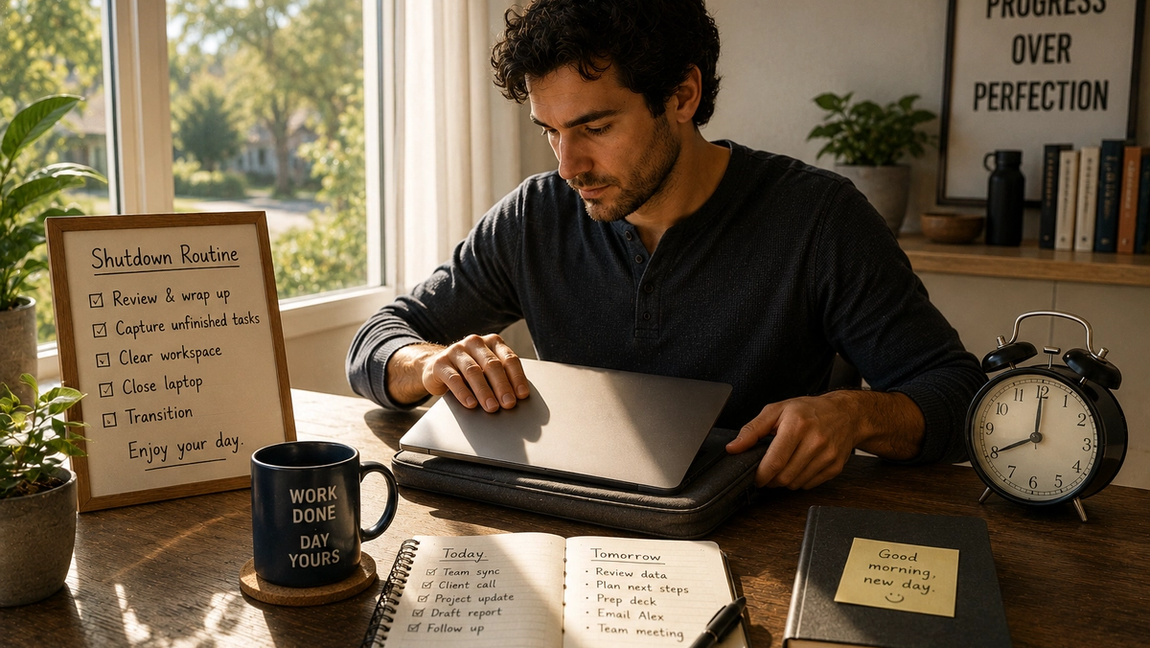
Instead of trying to mentally hold all of this information, create a short end-of-day list. Write down unfinished tasks, tomorrow’s priorities, and anything you are afraid you will forget.
The list does not need to become an elaborate planning system. Its purpose is simply to reassure your brain that the information has been captured somewhere reliable.
Once something is written down, you no longer need to repeatedly remind yourself about it while trying to relax.
Build a shutdown ritual
Rituals help create transitions. Your morning routine tells your brain the day is beginning. A similar routine can signal that work is finished.
Spend five or ten minutes closing open tabs, reviewing tomorrow’s schedule, clearing your desk, and putting away whatever you use for work. Then shut the laptop.
If you work from home, physical changes can be particularly useful. Put the laptop in a drawer. Close the office door. Move to another room. Change clothes. Take a short walk around the block.
None of these actions is magical on its own. Their power comes from repetition. When the same sequence happens every evening, it becomes associated with the transition out of work.
You are creating your own version of leaving the office.
Stop carrying your inbox in your pocket
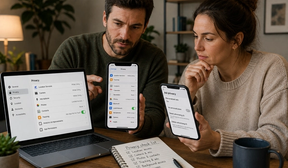
Logging off becomes significantly harder when work continues sending notifications to the device you use all evening.
If your job allows it, turn off work email and messaging notifications after your workday ends. Use scheduled focus modes or notification settings so they automatically return the next morning.
You do not necessarily need to remove work apps from your phone. The important change is preventing them from repeatedly announcing themselves when you are trying to do something else.
If you need to remain available for genuine emergencies, create exceptions for the people or channels that actually qualify. Not every message deserves the same level of access to you.
The goal is to distinguish between being reachable when necessary and being continuously interruptible.
Create a transition between work and home
The traditional commute had plenty of disadvantages, but it accidentally provided something psychologically useful: transition time.
You left one environment, traveled somewhere, and entered another. Your brain had time to move between roles.
Remote work can eliminate that transition completely. One minute you are discussing a project, and thirty seconds later you are standing in the kitchen deciding what to make for dinner.
Recreate a small transition intentionally. Take a fifteen-minute walk after work. Exercise. Shower. Listen to music. Make tea and sit somewhere away from your workspace.
Choose something simple enough to repeat regularly.
The activity matters less than the message behind it: work happened over there; the rest of the evening happens here.
Don’t confuse thinking about work with working
Sometimes work follows you home without any device involved.
You replay a conversation with your manager. You mentally rewrite an email. You think about how you should handle tomorrow’s meeting. You solve problems in the shower and plan presentations while trying to fall asleep.
You cannot simply command your brain to stop thinking about work. Trying not to think about something can sometimes make it even more noticeable.
Instead, when a useful work thought appears, capture it quickly. Write a short note and return to what you were doing. If the thought is not useful—perhaps you are replaying a frustrating conversation for the sixth time—notice that too.
Not every work-related thought requires action simply because it appeared after hours.
Make your evening something you actually want to enter
Logging off is harder when there is nothing clearly waiting on the other side.
If the evening consists entirely of household tasks followed by scrolling on the same device you used all day, the transition from work to personal time can feel surprisingly weak.
Create something small to look forward to. Cook dinner while listening to music. Go for a walk. Exercise. Read. Watch a film intentionally rather than leaving random content running in the background. Meet someone. Work on a hobby.
Your evening does not need to become another optimized routine filled with productive activities. Rest is a legitimate plan.
The point is to have an alternative to remaining mentally half-at-work until bedtime.
Accept that some work will remain unfinished
This may be the hardest part.
There will almost always be another email you could answer, document you could improve, idea you could research, or task you could get ahead on. Modern knowledge work rarely provides the satisfying moment when everything is officially complete.
You have to decide that enough has been done for today.
That decision can feel uncomfortable, especially if you are ambitious or responsible for a lot. But continuing indefinitely does not necessarily produce better work. Rest, relationships, movement, hobbies, and sleep all need time that work could easily consume if you allow it.
Logging off is not pretending your responsibilities disappeared. They will still be there tomorrow.
Ending work is a skill
A good workday is not only about knowing how to begin and how to focus. It is also about knowing when to stop.
Create a clear ending time. Capture unfinished tasks. Close the laptop. Silence unnecessary work notifications. Give yourself a transition into the evening and resist reopening work simply because something crosses your mind.
Some days, you will still answer an email at 9 p.m. Some projects will genuinely require longer hours. Occasionally, an urgent problem really will be urgent.
Those exceptions do not need to become your default.
The workday does not always end because the work is finished. Sometimes it ends because you decided that today’s portion of it is.
And then you log off.