How to Get Better Sleep (Without Quitting Your Phone)
We’ve all heard the advice: if you want better sleep, put your phone away at least an hour before bed. It sounds reasonable. It also sounds completely unrealistic for a lot of people.
By Ricardo Turner on August 18, 2026
We’ve all heard the advice: if you want better sleep, put your phone away at least an hour before bed.
It sounds reasonable. It also sounds completely unrealistic for a lot of people.
Your phone might be where you set your alarm, answer the last few messages of the day, read the news, watch a show, listen to a podcast, or scroll for a few minutes before falling asleep. Telling people to simply stop using it ignores how deeply phones are built into modern routines.
The good news is that improving your sleep doesn’t necessarily require a total digital detox. What matters more is how you use your phone, what you use it for, and whether it keeps your brain engaged long after your body is ready for rest.
Understand what your phone is actually doing to your sleep
Phones can interfere with sleep in more than one way.
Screen light is one factor. Exposure to bright light in the evening can affect your body’s natural sleep-wake signals, particularly when a screen is bright and close to your face.
But light isn’t the whole story.
What you’re doing on your phone can be just as important. Reading an upsetting work email, arguing in a comment section, checking tomorrow’s schedule, or watching increasingly interesting videos can keep your brain alert.
Then there’s the simplest problem of all: time.
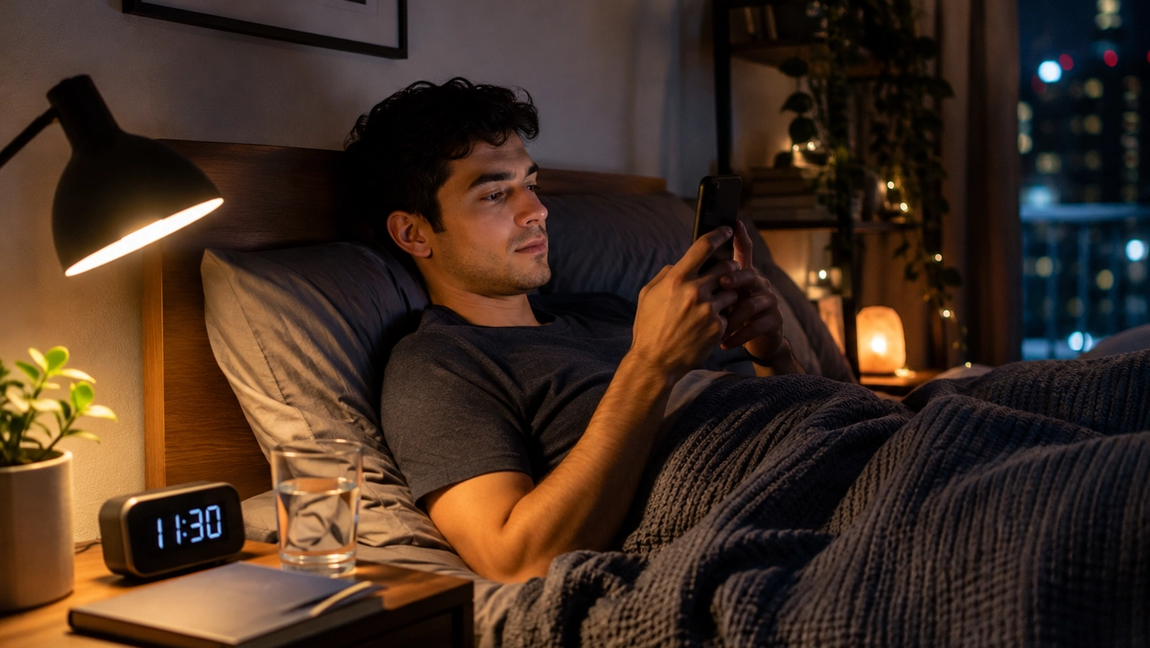
You intended to scroll for ten minutes. Suddenly, it’s 12:47 a.m.
So instead of treating your phone as the enemy, start by identifying which part of your phone use is actually costing you sleep.
Make your screen less stimulating at night
If you’re going to use your phone before bed, make it feel different from the phone you use during the day.
Lower the brightness. Turn on your device’s night display or warmer color settings. Use dark mode if you find it more comfortable in a dim room.
You can also reduce visual stimulation by removing unnecessary notifications from your lock screen and turning on Do Not Disturb or a similar focus setting.
The goal is simple: your phone at 11 p.m. shouldn’t feel like Times Square.
You want fewer flashing alerts, fewer reasons to open another app, and fewer opportunities for your attention to get pulled somewhere you didn’t intend to go.
Change what you do, not necessarily whether you use it
Not all screen time is equally stimulating.
There’s a big difference between listening to a familiar podcast and jumping between six social media apps. Likewise, reading something relaxing is different from checking work messages five minutes before trying to sleep.
Try creating a mental distinction between “daytime phone” and “bedtime phone.”
Your bedtime phone might be for:
- Reading an ebook
- Listening to calm music or a podcast
- Playing an audiobook
- Doing a short meditation
- Writing a few notes or tomorrow’s to-do list
- Watching something familiar and low-stakes
Meanwhile, work email, breaking news, heated group chats, endless short-form videos, and anything likely to trigger stress can wait until morning.
You don’t have to eliminate entertainment. You’re simply choosing forms of entertainment that have a natural stopping point.
Give scrolling an endpoint
One of the biggest problems with modern apps is that many of them never actually end.
There’s always another video, post, recommendation, or notification waiting for you.
That makes “I’ll stop when I’m tired” a surprisingly unreliable strategy.
Instead, create an external stopping point.
You could set a 20-minute timer when you get into bed. You might decide to watch one episode rather than scroll afterward. Or you could use your phone’s built-in app limits to make certain apps less accessible after a particular time.
The rule doesn’t need to be strict enough to annoy you. It just needs to interrupt autopilot.
When the timer goes off, ask yourself one question: “Do I actually want to keep doing this?”
Sometimes the answer will be yes. But you may be surprised by how often you realize you were scrolling simply because nothing had prompted you to stop.
Protect your bed from work
If there’s one type of phone use worth separating from bedtime, it’s work.
Checking email before bed can turn a calm evening into a mental meeting that lasts another hour.
You see a message from your boss. You remember something you forgot to do. Then you start mentally drafting tomorrow’s response while brushing your teeth.
Even if you can’t completely disconnect from work at night, establish a cutoff point whenever possible.
If you suddenly remember something important, write it down rather than solving it immediately. Your notes app can become a place to “park” tomorrow’s problems instead of carrying them into sleep.
The task will still be there in the morning.
Build a routine your brain can recognize
Good sleep habits aren’t only about avoiding things. They’re also about creating predictable signals that tell your body the day is ending.
Your routine doesn’t have to involve herbal tea, candles, and a 14-step skincare ritual.
It could be remarkably boring:
Shower. Brush your teeth. Dim the lights. Get into bed. Put your phone on Do Not Disturb. Read for 15 minutes. Sleep.
Doing roughly the same sequence each night can make bedtime feel less like an abrupt switch and more like a gradual transition.
Consistency matters elsewhere, too. Keeping your sleep and wake times reasonably regular, getting daylight during the day, exercising, and avoiding large amounts of caffeine late in the day can all support better sleep.
Your phone is only one piece of the puzzle.
Make your phone work for your sleep
The funny thing is that the device blamed for ruining sleep can also help protect it.
Use bedtime reminders. Automate Do Not Disturb. Set app limits. Lower screen brightness automatically in the evening. Put on white noise or calming audio. Use your alarm to maintain a consistent wake time.
Technology doesn’t automatically make sleep worse. Uncontrolled technology use often does.
You don’t need to become the person who leaves their phone charging in another room at 8 p.m. every night—unless that genuinely works for you.
A more realistic goal is to make your nighttime phone use quieter, darker, less stressful, and easier to stop.
Because better sleep doesn’t always require giving up your phone.
Sometimes it just requires teaching yourself when to put it down.