The Apps Worth Paying For (And the Ones to Cancel)
A few dollars a month does not sound like much. That is exactly why app subscriptions are so easy to accumulate.
By Jaxtyn Ellis on August 18, 2026
A few dollars a month does not sound like much. That is exactly why app subscriptions are so easy to accumulate. A streaming service costs less than dinner. A productivity app promises to organize your life for the price of a coffee. Cloud storage is only a few dollars. Add music, fitness, meditation, photo editing, news, and a couple of forgotten free trials, and suddenly you are paying a meaningful amount every month for digital services you barely notice.
The answer is not to cancel every subscription. Some apps genuinely make life easier, replace more expensive services, or provide enough entertainment to justify their cost many times over. The useful question is not whether an app costs money. It is whether you would actively choose to subscribe to it again today.
That distinction makes it much easier to decide what stays and what goes.
Pay for apps that solve a recurring problem
The easiest subscriptions to justify are the ones that repeatedly remove friction from your life.
Maybe you use a password manager across several devices every day. Perhaps cloud storage automatically protects thousands of photographs you would hate to lose. A navigation, language-learning, budgeting, or professional app might perform a specific function you genuinely rely on.
Frequency matters, but usefulness matters more. An app you open only twice a month can still be worth paying for if those two uses solve an important problem. Meanwhile, something you open every day may not be particularly valuable if you are mostly using it out of habit.
Ask what would happen if the app disappeared tomorrow. Would you immediately look for a replacement? Would something become noticeably harder? If the answer is yes, the subscription is probably doing real work.
If the answer is “I would barely notice,” that tells you something too.
Entertainment subscriptions need to earn their place
Streaming subscriptions are especially easy to accumulate because each service has something you might eventually want to watch.
The problem is that you can only watch so much.
Instead of maintaining five services year-round because each has one interesting series, rotate them. Subscribe to one or two, watch what you actually want, cancel, and switch when something elsewhere becomes worth seeing.
The same logic applies to gaming, audiobook, podcast, and digital reading subscriptions. The important question is not whether the service contains good content. Almost every major platform does. The question is whether you are currently using enough of that content to justify paying every month.
A subscription is not a lifetime commitment. Canceling something does not mean you can never use it again. You can always return when the service has something you genuinely want.
Be skeptical of productivity subscriptions
Productivity apps occupy a particularly clever corner of the subscription economy because they sell the possibility of becoming a more organized version of yourself.
There are excellent task managers, calendars, note-taking platforms, writing tools, and project management apps worth paying for. But there is also a common pattern: you discover a new system, spend an afternoon setting it up beautifully, use it enthusiastically for two weeks, and eventually return to whatever you were doing before.
The subscription continues.
Before paying for another productivity tool, ask whether the problem is actually the software. If you already have three places to write a to-do list, a fourth probably will not solve procrastination.
The best productivity app is often the one you consistently use, even if it has fewer features than the exciting new alternative.
Pay when the free version genuinely gets in the way
Many apps use a freemium model: the basic version costs nothing, while advanced features require a subscription.
There is no reason to pay simply because a premium option exists.
Use the free version until you encounter a real limitation. Perhaps advertisements become genuinely disruptive. Maybe you need offline access, additional storage, better exporting, synchronization across devices, or a professional feature that saves meaningful time.
At that point, upgrading has a clear purpose.
Paying in advance for features you imagine you might eventually need is different. Software companies are very good at making premium functionality sound essential even when most users will never touch half of it.
Let your actual behavior determine when you upgrade.
Cancel subscriptions built around your aspirational self
Some subscriptions belong to the person you imagine you are going to become.
You pay for the workout app because you are definitely going to exercise five times a week. You subscribe to a language platform because this is finally the year you become fluent in Italian. You keep the premium meditation membership because you intend to start meditating every morning.
There is nothing wrong with investing in goals. But after several months, look at what actually happened.
If you are using the service, keep it. If you are not, canceling the subscription does not mean abandoning the goal. It simply means that this particular tool is not currently helping you achieve it.
You can exercise without that fitness app. You can return to language learning later. You can meditate without paying a monthly fee.
Do not keep paying for evidence of your intentions.
Watch out for annual-plan psychology
Annual subscriptions often look like obvious bargains. Pay for ten months and get twelve. Save 30 percent by committing for the year. The monthly equivalent suddenly appears tiny.
But a discount only saves money if you would have remained subscribed anyway.
Before choosing an annual plan, consider whether you have already used the service consistently for several months. If you discovered the app yesterday, paying for an entire year because the per-month price looks better may simply lock you into something you stop using by October.
Annual plans make the most sense for services with established value in your life: software you use professionally, storage you know you need, or entertainment services your household uses constantly.
For experimental subscriptions, monthly flexibility may be worth the slightly higher price.
Audit the subscriptions you forgot existed
The most wasteful subscription is often not one you actively dislike. It is one you forgot you were paying for.
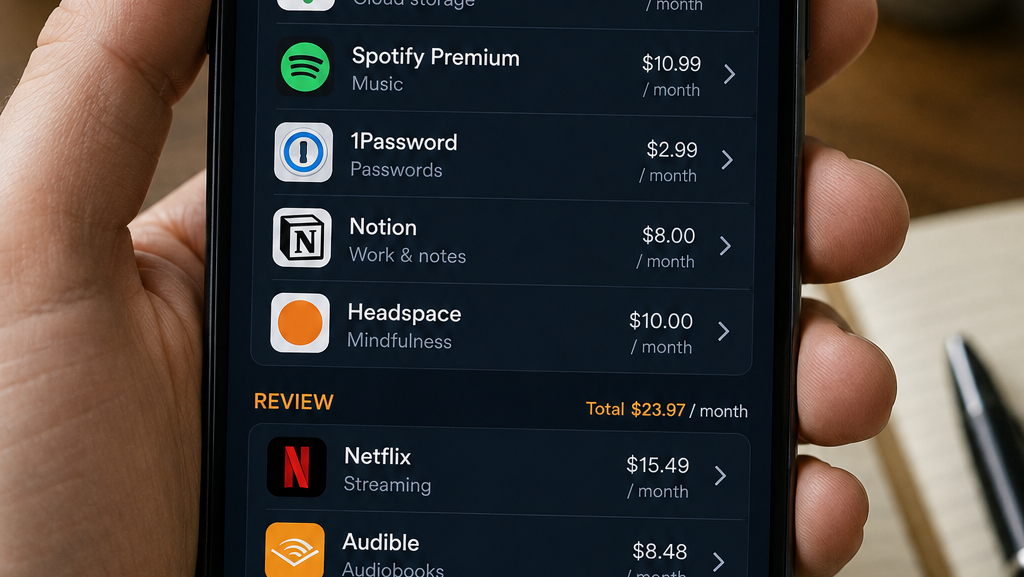
Check your phone’s subscription settings, bank statements, PayPal payments, and credit card charges. Look for services you no longer recognize or apps you have not opened recently.
Pay particular attention to small charges. A forgotten €3.99 subscription feels insignificant, which is why it can survive unnoticed for years.
Do this a few times a year rather than waiting until subscription costs become frustrating. Ten minutes of reviewing recurring payments can uncover surprisingly easy savings.
If you cannot remember what a subscription does without looking it up, it probably deserves immediate scrutiny.
Calculate value by use, not just price
An expensive app can be better value than a cheap one.
If you pay €100 a year for software you use professionally every working day, the cost per use is tiny. A €20 annual subscription you open twice is comparatively expensive.
This does not mean every frequently used app deserves your money. But thinking in terms of value rather than sticker price can make subscription decisions clearer.
Ask whether the app saves time, improves an experience you genuinely care about, protects something valuable, helps you earn money, or replaces something that would otherwise cost more.
If it does none of those things, you may simply be paying because canceling requires more effort than doing nothing.
Make subscriptions prove themselves
Subscription businesses benefit from inertia. Once you subscribe, the easiest option is to continue paying.
Reverse that logic.
Every subscription should occasionally have to justify why it is still there. If you would immediately miss it, keep it. If you use it constantly and enjoy it, keep it. If it saves you meaningful time or makes something important easier, keep it.
But if you are paying because you might use it someday, because canceling feels annoying, or because the annual plan seemed like a good deal eight months ago, let it go.
You can always subscribe again.
The apps worth paying for are not necessarily the most impressive ones. They are the ones that consistently earn a place in your actual life—not the life you imagine you might start living next Monday.