The Cultural Power of Paying Attention
Attention sounds like a personal matter. You decide what to read, what to watch, who to listen to, and what deserves your time.
By Elian Brady on August 18, 2026
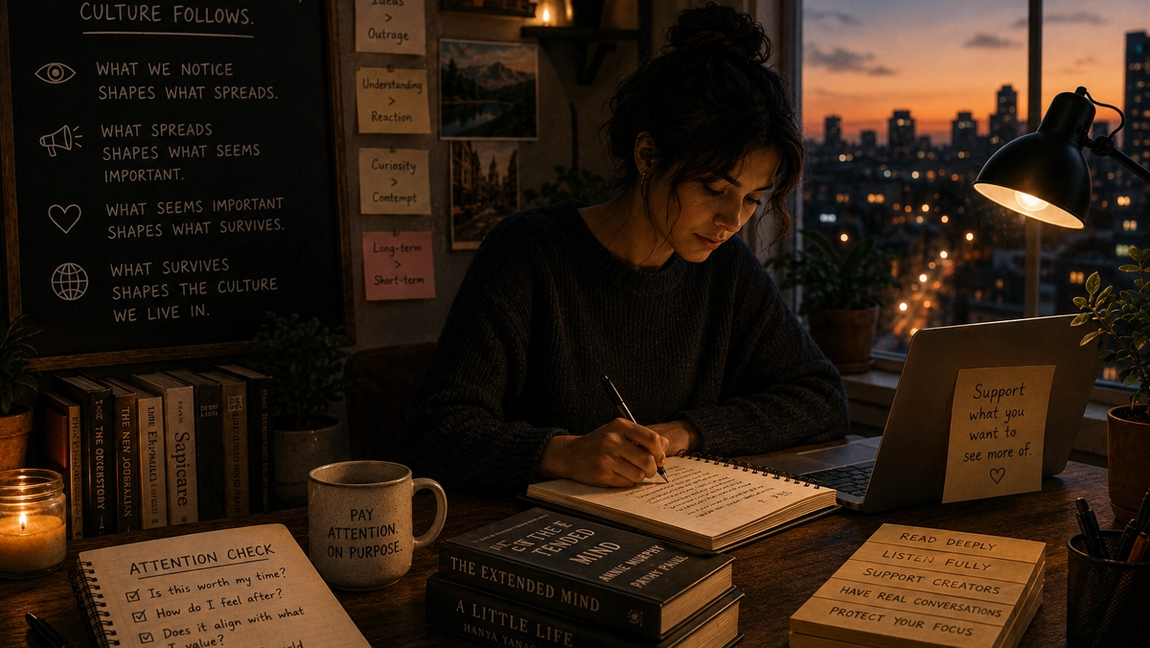
Attention sounds like a personal matter. You decide what to read, what to watch, who to listen to, and what deserves your time. But multiply those choices across millions of people and attention becomes something much bigger. It helps determine which ideas spread, which creators succeed, which stories dominate public conversation, and which issues quietly disappear from view.
This makes attention one of the most valuable resources in modern culture. Technology companies compete for it, advertisers pay for it, creators build careers around capturing it, and media organizations measure it in clicks, views, watch time, and engagement. Every day, countless people and organizations are asking essentially the same question: how do we make someone look at this?
Paying attention, then, is not entirely passive. What we choose to notice—and what we repeatedly ignore—helps shape the culture around us.
Attention has become an economy
For much of history, information was relatively scarce. Today, the problem is almost the opposite. A person with an internet connection has access to more articles, videos, music, books, podcasts, photographs, opinions, and entertainment than they could consume in several lifetimes.
When information becomes abundant, attention becomes scarce.
Platforms therefore compete not simply to provide content but to keep people engaged. A video automatically leads to another video. Notifications encourage you to return. Headlines are written to make scrolling past them difficult. Recommendations become increasingly personalized to what has previously kept you watching.
None of this means technology is inherently harmful. Recommendation systems can help people discover extraordinary books, music, communities, and ideas. The larger point is that your attention has economic value. If a service is built around keeping you engaged, it has a reason to become extremely good at capturing your focus.
Understanding that changes the question from “Why can’t I concentrate?” to something more useful: “What is competing for my concentration?”
What gets attention starts to look important
Popularity and importance are not the same thing, but online they can become surprisingly difficult to separate.
When a topic appears repeatedly in your feed, it begins to feel culturally significant. When thousands of people are discussing the same controversy, it can seem as though everyone is talking about it. When a video has millions of views, we may assume there must be something worth seeing.
But attention is not distributed according to importance alone. Content can spread because it is funny, shocking, emotionally charged, visually satisfying, controversial, or simply easy to consume. A complicated issue affecting millions of people may receive less attention than a celebrity argument that can be understood in thirty seconds.
This creates a strange cultural feedback loop. Something receives attention because it is attention-grabbing, and then it receives even more attention because everyone can see that it is already receiving attention.
The result is a world in which visibility can easily be mistaken for significance.
Outrage is unusually good at capturing us
Some emotions are particularly effective at holding attention, and anger is one of them.
A thoughtful argument may require several minutes to understand. An outrageous statement can provoke a reaction almost instantly. That makes outrage extremely compatible with systems that reward clicks, comments, shares, and rapid engagement.
The problem is not that people should stop being angry. There are plenty of situations where anger is reasonable and necessary. The problem arises when we repeatedly give attention to things primarily because they make us angry.
Every furious reply, quote, share, or reaction can give the original content more visibility. Something we dislike can therefore occupy enormous cultural space partly because people cannot stop responding to it.
Sometimes engaging is worthwhile. Sometimes criticism matters. But not everything offensive, ridiculous, or provocative deserves to become the center of public conversation.
Ignoring something can occasionally be more powerful than arguing with it.
Paying attention supports what survives
Attention does not only amplify negative things. It can also sustain valuable ones.
Reading an independent publication helps create demand for its journalism. Buying a book gives an author a reason to write another. Attending a local performance supports the people who created it. Spending time with thoughtful long-form work signals that there is still an audience for things that cannot be consumed in fifteen seconds.
Cultural ecosystems respond to what people consistently choose.
If audiences only click sensational headlines, publishers have incentives to produce more of them. If people pay for careful reporting, there is a stronger economic case for careful reporting. If viewers consistently reward original work, creators have more reason to make it.
Individual choices may feel insignificant, and one person’s behavior rarely transforms an industry. Collectively, however, attention creates demand.
What we pay attention to is partly a vote for what we want more of.
Deep attention changes what culture can produce
Some cultural experiences require more than a few seconds of concentration. A complex novel asks you to remember characters and ideas across hundreds of pages. A serious documentary may take two hours to develop an argument. A symphony, long conversation, museum visit, or detailed investigation asks you to remain with something rather than immediately searching for the next stimulus.
If our capacity for sustained attention weakens, it does not only affect individual productivity. It can also influence which forms of culture remain commercially and socially viable.
Creators adapt to audiences. If people increasingly abandon anything that does not become interesting immediately, cultural products have an incentive to become faster, shorter, louder, and easier to process.
That does not mean short-form content is inferior. A photograph can communicate something extraordinary in a second, and a short video can be genuinely creative or informative. The problem is not brevity. It is losing the ability to engage with anything that requires patience.
A healthy culture has room for both.
Attention is also how we show people they matter
The cultural power of attention becomes especially clear in ordinary human relationships.
Giving someone your full attention has become surprisingly noticeable. A conversation without checking your phone feels different. Being genuinely listened to feels different. Spending an afternoon with someone without constantly documenting or interrupting the experience feels different.
Attention communicates importance in a way that words sometimes cannot. When you repeatedly interrupt someone to look at your phone, you are not necessarily trying to say that the phone matters more. But that can still be how the interaction feels.
The reverse is equally powerful. Looking at someone, listening carefully, remembering what they told you, and asking a thoughtful question are small ways of saying, “For this moment, you matter enough to have my attention.”
That has always been meaningful. In an age of constant distraction, it may be becoming even more so.
Choose what gets to occupy your mind
You cannot control everything competing for your attention. You will click things you wish you had ignored, lose twenty minutes to meaningless scrolling, and become temporarily fascinated by controversies you will forget a week later.
The goal is not perfect attention. It is more intentional attention.
Notice which sources consistently leave you informed rather than agitated. Spend time with work that rewards concentration. Support creators and institutions producing things you want to continue existing. Give important conversations more attention than incoming notifications. Occasionally ask whether the thing dominating your screen actually deserves the amount of mental space it is receiving.
Attention may feel invisible because you spend it continuously.
But time follows attention, money often follows attention, and culture eventually follows attention too.
What we repeatedly choose to look at does more than fill our days. Collectively, it helps decide what the world produces next.