The Quiet Return of Real-Life Hobbies
For a while, it seemed as though every hobby needed to become something more. If you baked well, perhaps you should start selling cakes. If you enjoyed photography, you could build a following. If you knitted, painted, ran, gardened, or collected something, there was probably a way to monetize it, track it, optimize it, or turn it into content.
By Kinley Hardin on August 18, 2026
For a while, it seemed as though every hobby needed to become something more. If you baked well, perhaps you should start selling cakes. If you enjoyed photography, you could build a following. If you knitted, painted, ran, gardened, or collected something, there was probably a way to monetize it, track it, optimize it, or turn it into content.
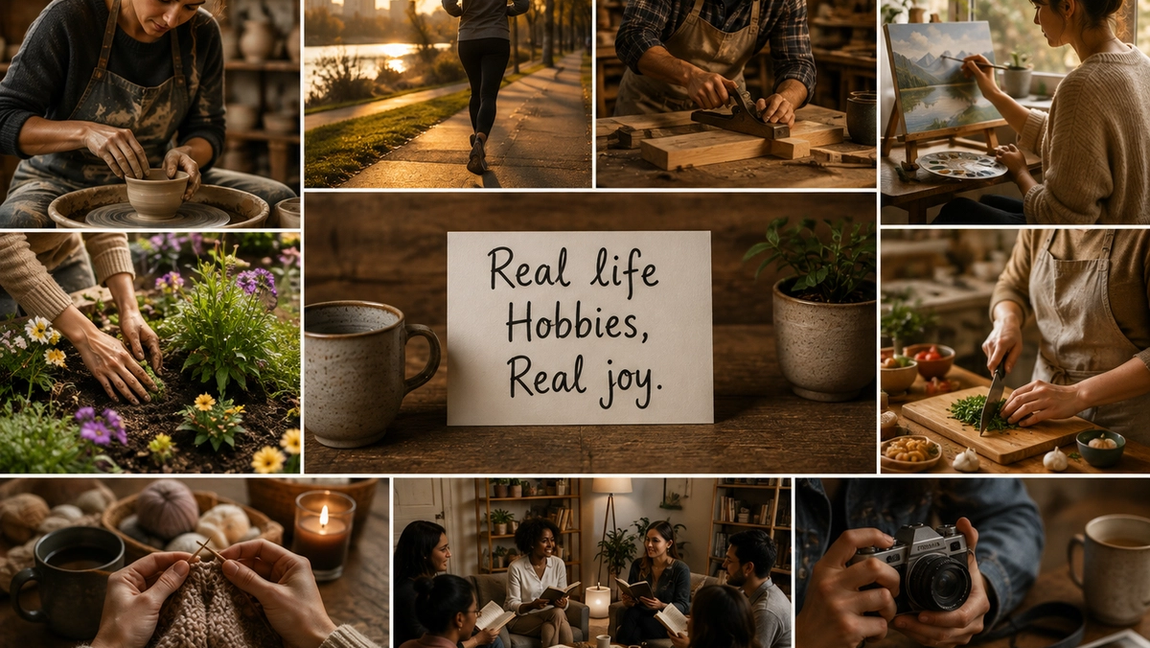
Now, something quieter seems to be happening. People are returning to hobbies that exist primarily offline: pottery, running clubs, gardening, sewing, painting, puzzles, cooking, book clubs, film photography, woodworking, and countless other activities that require your hands, your attention, and often a surprising amount of patience.
The appeal is not necessarily nostalgia or a rejection of technology. It may be something simpler. After spending so much of life looking at screens, doing something tangible for no reason other than enjoying it can feel unusually satisfying.
We spend more of life in digital spaces
A large part of modern life happens through screens. Many people work on computers, communicate through messaging apps, shop online, manage their finances digitally, follow the news on their phones, and finish the day by watching something on another screen.
Digital tools make countless tasks easier, but they can also create a strange sameness. Work, entertainment, communication, and administration all happen through slightly different rectangles.
Real-life hobbies provide a physical contrast.
When you make pottery, your hands are actually shaping something. When you garden, the plants grow according to their own schedule rather than responding instantly to a click. When you cook, ingredients change texture, smell, and taste. When you run, progress is experienced through your body rather than displayed only as information on a screen.
Physical activities give us something digital life sometimes struggles to provide: the feeling of interacting directly with the world.
Hobbies give us permission to be beginners
Adult life does not provide many opportunities to be openly bad at something.
At work, competence is expected. Responsibilities need to be handled. Mistakes can have consequences. Even leisure activities can become strangely competitive once performance metrics enter the picture.
A hobby can create a different environment. You can make an ugly ceramic bowl and keep it anyway. You can spend months learning three songs on the guitar. You can paint something nobody else will ever see.
There is freedom in doing something without needing to be impressive.
Being a beginner also changes the way you pay attention. You have to notice small improvements because large ones take time. The first loaf of bread may be terrible, the tenth acceptable, and the fiftieth something you are genuinely proud of.
In a culture that often celebrates expertise and polished results, hobbies remind us that there is value in being inexperienced and continuing anyway.
Not everything needs to become income
The internet has made it easier than ever to turn a skill into a business. That can be genuinely empowering. Someone who loves making jewelry can find customers around the world, and a photographer can build a career without waiting for traditional gatekeepers.
But the possibility of monetizing almost anything can also change how we experience hobbies.
Once money enters the equation, the questions change. Instead of “Do I enjoy making this?” you start asking whether people will buy it. You think about pricing, marketing, growth, algorithms, customer expectations, and whether your time is being used efficiently.
The hobby becomes work.
There is nothing wrong with building a business around something you love. But there is also value in protecting activities that do not need to produce anything beyond enjoyment.
You are allowed to be good at something without selling it.
You are also allowed to be terrible at something and keep doing it anyway.
Making something tangible feels different
Many forms of modern work produce invisible results. You send emails, update documents, attend meetings, edit files, and move information from one digital location to another. At the end of a long day, you may have accomplished a great deal without having anything physical to show for it.
Real-life hobbies often provide a clear sense of completion.
You cooked the meal. You finished the puzzle. You knitted the scarf. You repaired the chair. You planted the herbs. You developed the photograph.
The result exists in front of you.
That tangible feedback can be deeply satisfying because progress becomes visible. A half-finished painting looks different from a completed one. A garden changes across months. A stack of books you have read accumulates on a shelf.
Not every hobby needs to produce an object, of course. Dancing, hiking, swimming, and playing sports are experiences rather than products. But they still happen physically, giving your attention somewhere concrete to go.
Hobbies can rebuild local community
Digital communities can be enormously valuable, especially for people who struggle to find others with similar interests nearby. But online connection and physical presence offer different things.
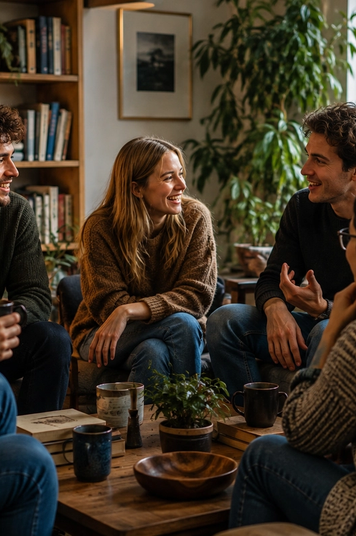
A running club brings people together repeatedly without requiring them to organize a formal social event. A pottery class creates conversation around a shared activity. A book club gives people a reason to meet regularly. Community gardens put neighbors in the same physical space.
This matters because adult friendships can be surprisingly difficult to build. Many people meet others through work but have fewer natural opportunities to develop relationships outside it.
Hobbies create repeated, low-pressure contact. You already have something to talk about, and nobody has to invent a reason to meet again next week.
Sometimes the activity itself becomes secondary to the community that forms around it.
Offline activities protect attention differently
Many digital activities are built around constant choice. Finish one video and another appears. Read one post and there are hundreds below it. Open a news story and several other headlines compete for your attention.
Physical hobbies tend to have clearer boundaries.
When you are knitting, there is a piece of fabric in front of you. When you are running, there is a route. When you are assembling a puzzle, there is one puzzle.
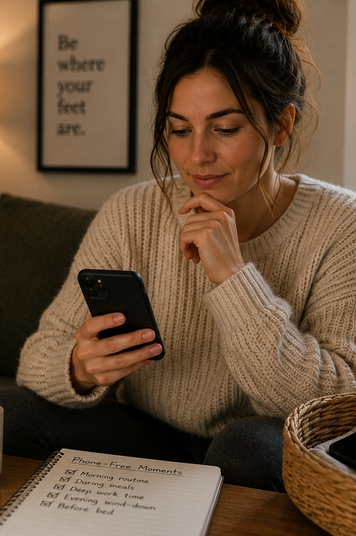
Your mind can still wander, and your phone can still interrupt you, but the activity itself does not constantly offer another option.
This can make hobbies feel unusually absorbing. You stop checking the time. Your attention narrows. For an hour, the rest of life becomes slightly quieter because your hands and mind have somewhere specific to be.
You don’t have to document everything
One of the strangest shifts in modern leisure is how quickly an experience can become content. You make something beautiful and immediately think about photographing it. You visit somewhere interesting and begin considering what to post.
There is nothing wrong with sharing things you enjoy. But there can also be something freeing about having experiences that leave no digital evidence.
Make dinner and eat it before photographing it. Paint something and put it in a drawer. Take a walk without recording the route. Read a book without announcing that you are reading it.
A hobby can belong entirely to you.
When there is no audience, you may also notice that your choices change. You stop wondering what looks interesting and start discovering what actually feels interesting.
The point may be that there is no point
Real-life hobbies do not need to make you more productive, healthier, more interesting, or more employable. They can do some of those things, but turning every hobby into a self-improvement strategy misses part of their appeal.
Sometimes you knit because you like knitting. You garden because you like seeing things grow. You play football because Tuesday evenings are better when you play football.
That lack of larger purpose can be surprisingly valuable.
Much of adult life is organized around outcomes. Work needs results. Money needs managing. Responsibilities need completing. Even rest is increasingly discussed in terms of helping us become more productive afterward.
A hobby can exist outside that logic.
Perhaps that is why real-life hobbies feel so appealing right now. They give us somewhere to put our attention that does not need to become content, income, optimization, or achievement.
You do something because you enjoy doing it.
And sometimes, that is more than enough.