Why the Slow Things Are Quietly Winning
For years, faster seemed automatically better. Faster delivery, faster communication, faster growth, faster careers, faster content, faster results.
By Dion Spears on August 18, 2026
For years, faster seemed automatically better. Faster delivery, faster communication, faster growth, faster careers, faster content, faster results. Businesses celebrated speed, technology eliminated waiting, and entire industries were built around helping us save a few more minutes. If something could be made more efficient, the assumption was that it should be.
And yet, something interesting is happening alongside all that acceleration. People are buying physical books, running marathons, baking bread, growing vegetables, learning crafts, listening to long-form podcasts, collecting vinyl, and traveling specifically to walk for days through places they could cross much faster by car. In a culture designed around convenience, many people are voluntarily choosing activities that take more time.
The slow things never really disappeared. We may simply be remembering why some experiences lose their value when we try to make them faster.
Convenience has made patience feel unusual
A generation ago, many ordinary activities involved waiting. Photographs had to be developed. A person who was not home could not immediately answer you. A package might take weeks to arrive. If you wanted to watch a particular movie, you often had to wait until you could find it somewhere.
Most people would not seriously want all of those inconveniences back. Faster technology has solved countless real problems and made information, communication, entertainment, and services dramatically more accessible.
But when almost everything becomes immediate, waiting starts to feel different. A webpage taking five seconds to load can feel irritating. A message left unanswered for several hours can create anxiety. A television series that once unfolded over months can be consumed in a weekend.
Our expectations have accelerated alongside the technology.
Slow experiences interrupt that expectation. They require us to remain with something longer than is strictly necessary, which can feel frustrating at first and surprisingly satisfying afterward.
Some things improve because they take time
Efficiency works brilliantly for tasks where the process itself has little value. Few people want paying a bill or renewing a document to take longer than necessary.
But other experiences depend partly on time.
Learning a language cannot be compressed into a weekend. Building physical strength requires repeated effort and recovery. Friendship develops through accumulated conversations and shared experiences. Expertise comes from years of practice, mistakes, feedback, and adjustment.
Trying to accelerate these processes can sometimes undermine the thing you are trying to create.
This is especially visible in creative work. Writing something meaningful, developing an original idea, designing a great product, or mastering an instrument often involves periods that look inefficient from the outside. You experiment, get stuck, abandon ideas, return to them, and gradually improve.
The slow part is not always an obstacle to the result. Sometimes it is how the result becomes possible.
Physical experiences are becoming more valuable
The more life moves onto screens, the more appealing physical experiences can become.
A paper book does less than an e-reader or phone. It cannot send notifications, play a video, open another tab, or instantly search a word across the internet. That limitation can become part of its appeal. There is only the book and your attention.
The same applies to activities such as gardening, pottery, cooking, woodworking, running, and painting. They involve physical processes that resist infinite acceleration. Bread still needs time to rise. Plants still grow according to biological schedules. You cannot become an experienced runner by watching running videos at double speed.
These activities create boundaries that digital life often lacks. They demand attention but do not necessarily demand constant decisions about what to click next.
In a world of unlimited options, limitations can feel unexpectedly restful.
Long-form attention is becoming a luxury
Much of modern media is designed to compete for seconds of attention. Headlines become shorter, videos become faster, and information is compressed into increasingly small pieces.
Short content is useful. Sometimes you genuinely need the answer in thirty seconds.
But compression has limits. Complicated subjects require context. Interesting conversations need room to wander. Some stories need hundreds of pages rather than fifteen bullet points.
This may help explain the continued appeal of long-form books, newsletters, essays, documentaries, and multi-hour podcasts. They ask for more attention, but they can also offer something fragmented media struggles to provide: depth.
Spending an hour with one idea can feel almost radical when you are accustomed to encountering fifty ideas in the same amount of time.
The scarcity is no longer necessarily information. We have more information than we could consume in several lifetimes. The scarce resource is sustained attention.
Slow growth can be stronger growth
The obsession with speed extends beyond technology and into how we think about success. Businesses are expected to scale quickly. Careers should accelerate. Audiences should grow. Results should appear.
Rapid growth can be extraordinary, but it can also hide weaknesses. A company can acquire customers faster than it learns how to serve them. A creator can build an enormous audience before developing the systems needed to sustain it. A person can advance professionally while quietly becoming exhausted.
Slower growth gives systems time to develop alongside success. Skills improve. Processes get tested. Relationships deepen. Mistakes happen at a scale where they can still be corrected.
This does not mean slow is always superior. Sometimes speed creates enormous advantages, and opportunities genuinely have deadlines. The point is that speed and progress are not identical.
Something can grow slowly and still be moving in exactly the right direction.
Waiting can increase the value of an experience
Anticipation has almost disappeared from some parts of modern life. You hear about a film and can watch it immediately. You want something and order it in seconds. You wonder about something and have the answer before finishing the thought.
Instant access is convenient, but anticipation has its own pleasure.
Planning a trip for months allows the experience to exist in your imagination before it happens. Waiting for a special meal can make the meal feel different. Saving money for something can make buying it more meaningful than purchasing it impulsively.
Not everything becomes better through waiting, of course. Nobody needs to romanticize a delayed train.
But removing every gap between wanting and receiving can also remove some of the emotional experience that happens in between.
Slow doesn’t mean inefficient
The case for slower living can easily become nostalgia for a past that was far less convenient than we remember. Speed has improved lives in countless ways, and there is no particular virtue in making easy things unnecessarily difficult.
The more useful distinction is between things that benefit from efficiency and things that benefit from attention.
Automate the boring administrative task. Take the faster train. Use technology to eliminate work that does not need to exist.
Then consider where speed might be costing you something.
Maybe the conversation deserves another hour. The book deserves your full attention. The business needs another year to mature. The skill requires more practice. The meal is worth cooking properly.
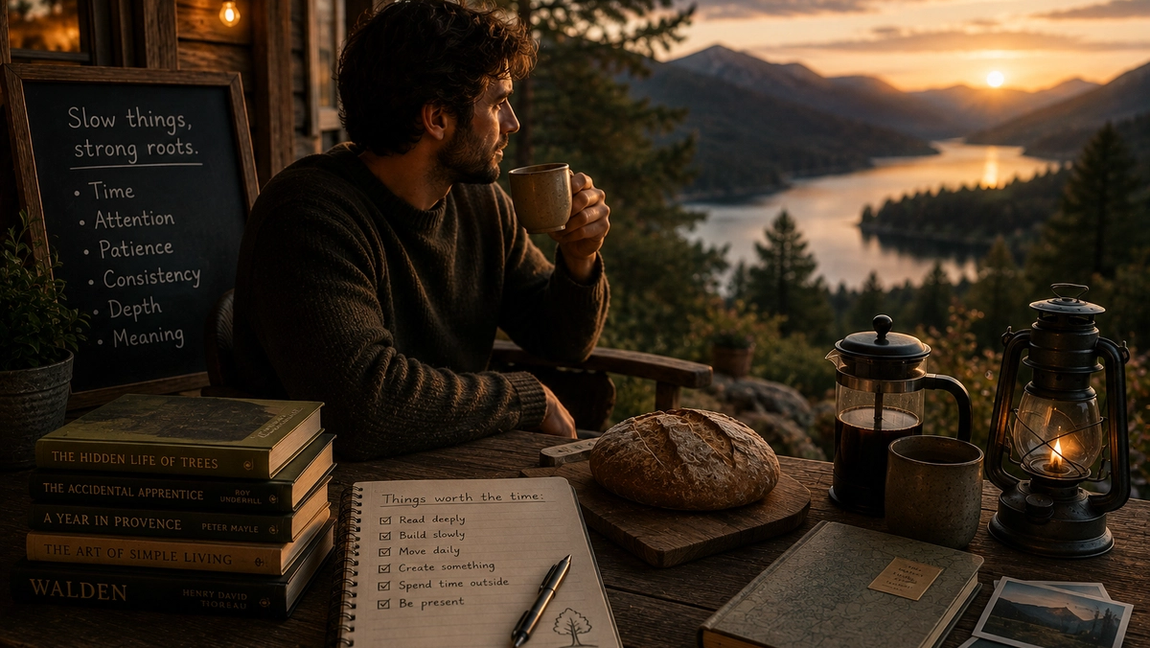
The slow things are not winning because the world has suddenly stopped moving quickly. They are becoming valuable precisely because it hasn’t.
When almost everything can be made faster, choosing what deserves time becomes a form of discernment.
Some things are worth waiting for. Others are worth working on for years. And a few of the best things in life may be valuable precisely because there is no shortcut to them.