Why We Romanticize the Lives of Strangers Online
You find someone’s account by accident. They live in a beautiful apartment, drink coffee from handmade ceramic cups, travel somewhere interesting every few months, and somehow always seem to be reading a book beside a perfectly positioned window.
By Charlie Wells on August 18, 2026
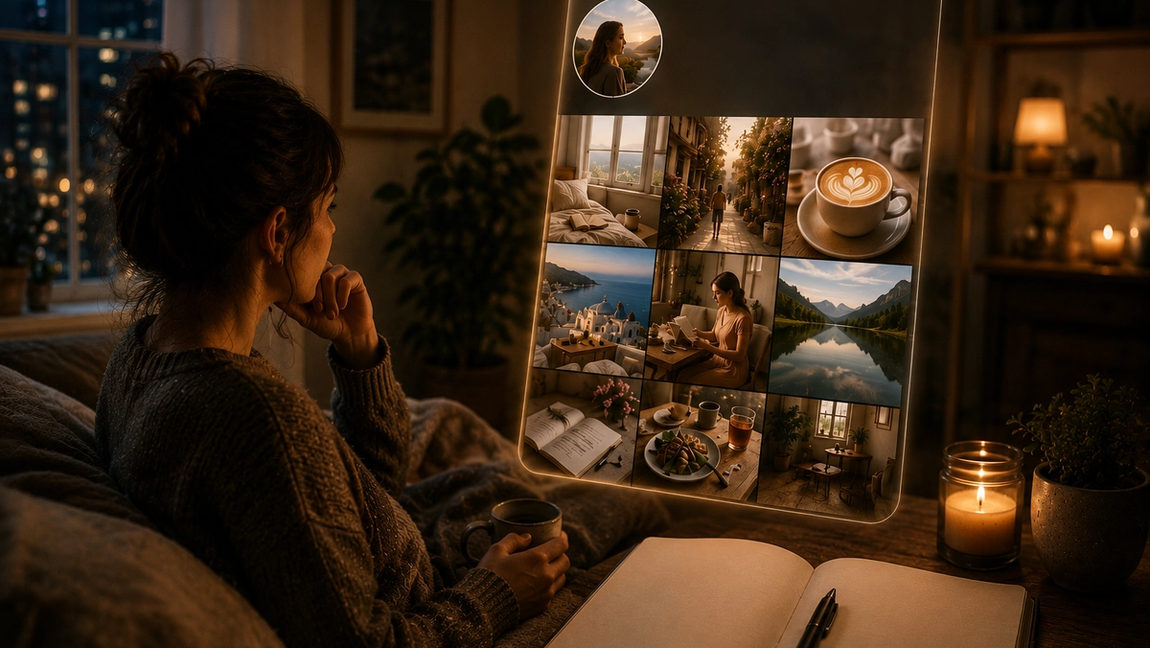
You find someone’s account by accident. They live in a beautiful apartment, drink coffee from handmade ceramic cups, travel somewhere interesting every few months, and somehow always seem to be reading a book beside a perfectly positioned window. After watching a few videos, you begin constructing an entire life around them. Their mornings must be peaceful. Their relationship looks effortless. Their career seems exciting. They appear to have figured out something you haven’t.
Of course, you do not actually know this person. You know their kitchen, their vacation photos, a few opinions, their outfits, and perhaps what they ate for breakfast on Tuesday. Everything else is being filled in by your imagination.
Social media gives us an unusual amount of access to other people’s lives while often giving us very little context. That combination makes strangers remarkably easy to romanticize. We see enough to become interested but not enough to see the full complexity of the person behind the screen.
We naturally fill in the missing information
Human beings are good at building stories from incomplete information. When we meet someone briefly, we form impressions based on how they speak, what they wear, how they behave, and whatever else is available. Online, we do something similar with much less evidence.
A photograph of a beautiful home becomes evidence of a peaceful life. A romantic anniversary post becomes evidence of a wonderful relationship. Frequent travel becomes evidence of freedom. Professional success becomes evidence of confidence and fulfillment.
The problem is not necessarily that anything we see is fake. The apartment may genuinely be beautiful. The relationship may genuinely be loving. The career achievement may be completely real. What we do not see is everything surrounding those moments.
Because the missing information is invisible, our brains often complete the picture using assumptions. We turn fragments into a coherent story, and the story can become much more appealing than the complicated reality probably is.
We compare their highlights with our entire lives
You experience your own life continuously. You see the laundry, bills, arguments, boring afternoons, unanswered emails, bad hair days, anxiety before appointments, and nights when dinner is whatever happens to be available in the refrigerator.
You experience a stranger’s life very differently.
You may see their weekend in Paris but not the stressful Monday afterward. You see the finished renovation but not the months of financial decisions and arguments behind it. You see a smiling family photograph but not the morning when everyone was exhausted and irritated.
This creates an inherently uneven comparison. You are comparing their selected moments with your unedited reality.
Even when you intellectually understand this, the emotional effect can remain powerful. Repeated exposure to beautiful fragments can make someone else’s life feel consistently better than yours simply because you are not being shown the ordinary parts.
Aesthetic consistency creates the illusion of a consistent life
Social media is especially good at turning lifestyles into visual identities.
Someone’s feed might be filled with neutral interiors, slow mornings, countryside walks, linen clothing, homemade food, and carefully photographed books. The consistency creates a story: this person lives a calm, intentional life.
But visual consistency is not the same as emotional consistency.
A person can own beautiful furniture and still feel overwhelmed. Someone can photograph a peaceful morning and spend the afternoon stressed about money. A perfectly styled dinner can happen during a difficult week.
The camera captures what is inside the frame. Our imagination supplies what is outside it.
When hundreds of posts maintain the same aesthetic, it becomes easy to assume that the aesthetic represents the person’s entire existence. In reality, it may simply represent what they enjoy photographing, what performs well online, or what they have intentionally chosen to share.
Distance makes people easier to idealize
The less you know about someone, the fewer contradictions you have to process.
People you know closely are complicated. Your best friend can be generous and occasionally selfish. Your partner can be wonderful and irritating. Your colleague can be talented in one area and completely disorganized in another.
Strangers online are easier.
You might know their taste in clothes, their career, and how they decorate their home without knowing how they behave when angry, how they handle conflict, what they worry about at night, or whether they leave dirty dishes in the sink for three days.
Distance allows you to preserve a simplified version of them.
This is similar to the way we sometimes romanticize celebrities, historical figures, or people we barely know in real life. Limited information creates space for projection. We can assign qualities to someone that may say as much about what we want as they do about who that person actually is.
Sometimes we’re romanticizing what they represent
Often, the stranger is not really the point.
Maybe you are fascinated by someone who lives in a small house in the countryside because you are exhausted by city life. Perhaps you follow a person who travels constantly because you want more adventure. Someone with a seemingly successful creative career may represent the freedom you wish you had in your own work.
In that sense, online envy can contain useful information.
Instead of asking, “Why isn’t my life like theirs?” ask, “What specifically about this life appeals to me?”
The answer may be surprisingly concrete. Maybe you do not want their life at all. You want more time outdoors. You want a home that feels calmer. You want to travel twice a year. You want to dress differently. You want mornings that are less rushed.
Once you separate the desire from the person, you can decide whether some version of it belongs in your own life.
Algorithms can make exceptional lives look normal
Social media does not necessarily show you a representative sample of humanity. It shows you content designed or selected to keep your attention.
That can create strange perceptions of what ordinary life looks like. If your feed contains enough luxury travel, expensive homes, elaborate weddings, perfect bodies, rapidly growing businesses, and people apparently retiring at 32, exceptional circumstances can begin to look standard.
Then your perfectly normal life starts feeling inadequate by comparison.
The solution is not necessarily to unfollow everyone successful or attractive. It is simply useful to remember that your feed is not a census. It is a highly selective stream shaped by what you follow, what you interact with, and what platforms predict will keep you interested.
What appears common on your screen may be extremely uncommon in reality.
You can enjoy the fantasy without believing it
There is nothing inherently wrong with enjoying beautiful glimpses into other people’s lives. Social media can provide inspiration, introduce you to places you want to visit, help you discover new interests, and expose you to ways of living you had never considered.
The problem begins when inspiration quietly becomes evidence that everyone else is living better.
When that happens, add back the missing context. Remember that you are seeing moments rather than an entire life. Notice when you have started inventing personality traits, relationship dynamics, or emotional states based on photographs and short videos.
Most importantly, pay attention to what the romanticized life is telling you about your own desires.
You probably do not actually want to become the stranger on your screen. You may simply want something their content represents: more beauty, freedom, creativity, connection, adventure, calm, or time.
That distinction matters.
The stranger’s life may not be nearly as perfect as you imagine. But the longing it creates can still tell you something real about the life you want to build.